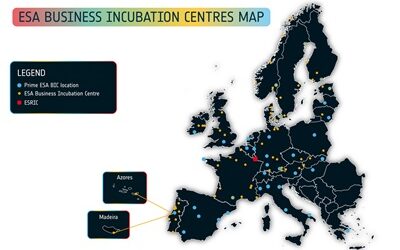
The European Space Agency’s business incubation centres (ESA BICs) are spread across Europe, with the Dutch one having its home at ESA BIC Noordwijk. Offering an open call for applications, this incubator welcomes an ever-expanding number of entrepreneurs this exciting community. Our location is situated at the heart of the space ecosystem in the Netherlands – connected to the wider network of 36 ESA BICs – and was the first ever ESA-supported incubation centre. Read on to discover why our ESA BIC has, historically, had a higher than average number of technology transfer innovations and meet the current incubatees innovating space tech to benefit life on Earth.
Do you have a space business idea? Answer the call for applications by 30 March 2026 >>
For over 20 years, ESA BICs have been providing entrepreneurs with equity-free funding, access to world-class technical expertise, including ESA experts and national technology institutes, as well as tailored business support. The network has delivered significant socioeconomic benefits, solidifying Europe’s position as a global leader in space-related innovation. The unique ESA-supported incubation programme assists startups working with downstream applications, technology transfer cases and upstream technologies. Though, when ESA BIC Noordwijk was established, the startups supported initially focused on technology transfer innovations and, recently, we have seen an increasing trend towards such space assets.
Development of space assets
The uniqueness of ESA BIC Noordwijk’s comparatively high number of startups working on technology transfer innovations (when compared to the other ESA BICs) can be explained by its origins. Niels Eldering, head of ESA’s Entrepreneurship and Business Incubation in the Commercialisation Services Department, has been there since the beginning of ESA BIC and recently commented about its origins: “Around the turn of the century, you saw more and more startups popping up in Europe. ESA had had a knowledge transfer programme for years, but that was focused on mature companies that wanted to bring technology from space to the market.” The switch was then made to create a startup programme. “The idea was to set up an incubator that would select promising startups with different application ideas from the space industry. And then support them with business and technical knowledge. ESA was eager to try that itself. Thus was born ESA BIC Noordwijk in 2004.”
“Startups are the pioneers of the economy. They are often just a little ahead of the rest of the market because they foresee major trends and developments. In the 20 years of the ESA BIC network’s existence, there have been three major developments,” Niels explains. “The first generation of startups brought hardware from space to other sectors, such as healthcare and logistics. The second generation saw the great promise of European satellite programmes like Galileo and Copernicus. Even before the satellites were launched, they paved the way for commercial-use scenarios. They started working on satellite applications for our society. There is also the generation focuses on NewSpace: they build rockets, satellites or components for a rapidly growing, international space economy.”
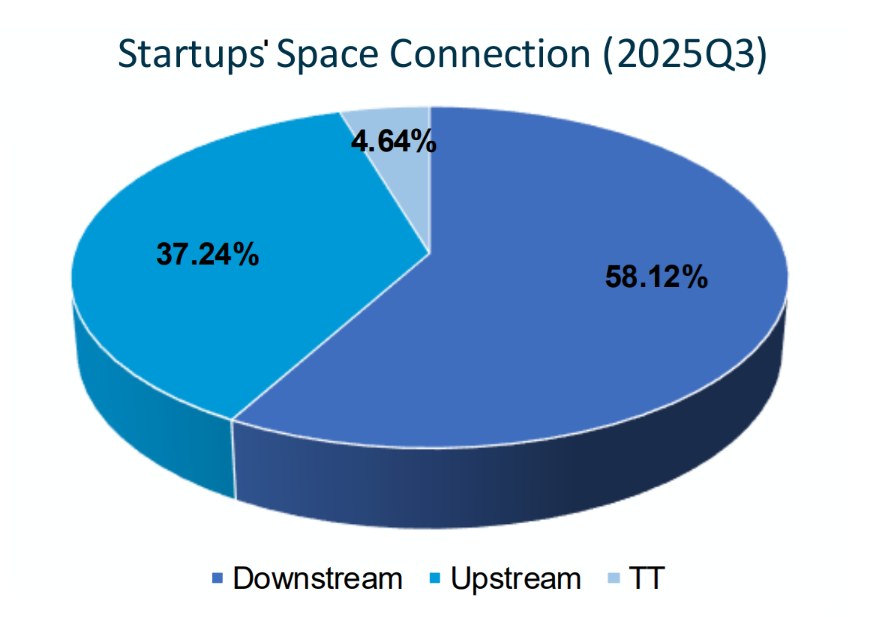
While, lately, the majority of startups supported at ESA BIC Noordwijk use satellite data for the development of downstream terrestrial applications – which is evident across the network (see visual summing the status as of 2025 Q3) – the trend for technology transfer innovations appear to be once again on the increase, if the current incubatees are anything to go by (over 50% currently are developing innovations based on technology transfer).
Technology transfer trend
The invaluable proximity to cutting-edge space research that is afforded to the startups at ESA BIC Noordwijk is always a positive influence on the focus of the entrepreneurs. The technology transfer innovations are utilised to bring space tech down to Earth and, over the years, have successfully provided solutions via the hardware, software, knowledge/processes or intellectual property (IP) first used for space applications. If you are interest to investigate the catalogue of patents for your own space business idea, your first step could be to take a look at ESA’s Space IP or the ESA Commercialisation Gateway website to discover technology transfer applications and businesses using space technologies.
From ESA BIC Noordwijk’s alumni portfolio, the earliest technology transfer innovation first started out under ESA’s incubation programme in 2005 with the development of Bradford Space’s ozonizer. More recently, there have been successful innovations from Skytree (graduated in 2012) for direct air capture, HDES (graduated in 2021) for cool gas generators (now being developed by its spin-off Solidflow) and NeoStove (graduated in 2022) for its space-inspired pan (now being produced under the company name Effium). Jump forward a few years and out of all the current ESA BIC incubated startups, over half of them are focusing on technology transfer solutions.
Current ESA BIC incubatees inspired by & repurposing space tech
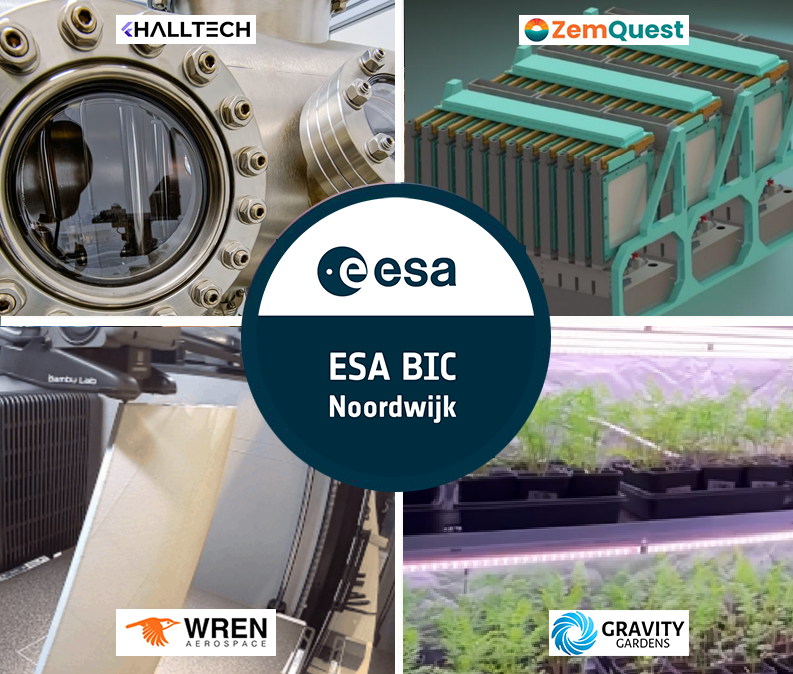
Here, we highlight the current incubatees that have all transfered space tech knowledge into their entrepreneurial ventues.
- GRAVITY GARDENS
Gravity Gardens innovates methodologies for efficient agricultural solutions

Space link:
Gravity Gardens is developing a novel, space-inspired agricultural technology that increases crop yields using minimal land. The focus is on scalability and simple integration to the current supply chain model. This technology leverages space principles, precision and optimisation, to create breakthroughs in terrestrial food production. Think of it as reimagining how food can be grown, with the potential to limit deforestation by increasing agricultural productivity. Read incubation interview
- HALLTECH
HallTech redefines physical vapour deposition for industrial manufacturing
Space link:
HallTech is transferring a technology from space to redefine physical vapour deposition (PVD) processes on Earth. Its innovation leverages a modified electrical propulsion device. The core technology that is the Hall-effect thruster (HET), used for manoeuvring satellites in space. However, the plasma plume created by the HET is not designed for PVD, as the environment is completely different. In the startup, there is all the expertise to make it optimal for PVD applications. Read incubation interview
- WREN AEROSPACE
Wren Aerospace leverages space tech to unlock the power of the stratosphere
Space link:
There are three aspects of space technology in the Wren aircraft. Firstly, there’s a composite structure akin to those developed for space missions. Next, is the hydrogen propulsion system, which needs to operate at minus 60 °C, which is something very different to using hydrogen on Earth. Finally, the third link is a novel control method is used, inspired by space re-entry vehicles to control the aircraft in the thin air of the stratosphere. Read incubation interview
- ZEMQUEST
ZemQuest delivers emission-free energy using aluminium as solid fuel

Space link:
In 1987, NASA sought a solution for electrical energy in single-use systems and went on to develop an aluminium–air battery concept, for which several patents followed that have since expired. ZemQuest has now repurposed the original design, upsizing and enhancing it to allow mechanical recharging, with the addition of rapid reactivation capability. The original design was much more difficult to reactivate – almost behaving more like a primary battery that you use and then you need to disassemble it completely and then reassemble with fresh aluminium in it, which is no longer necessary with the ZemQuest approach. Read incubation interview
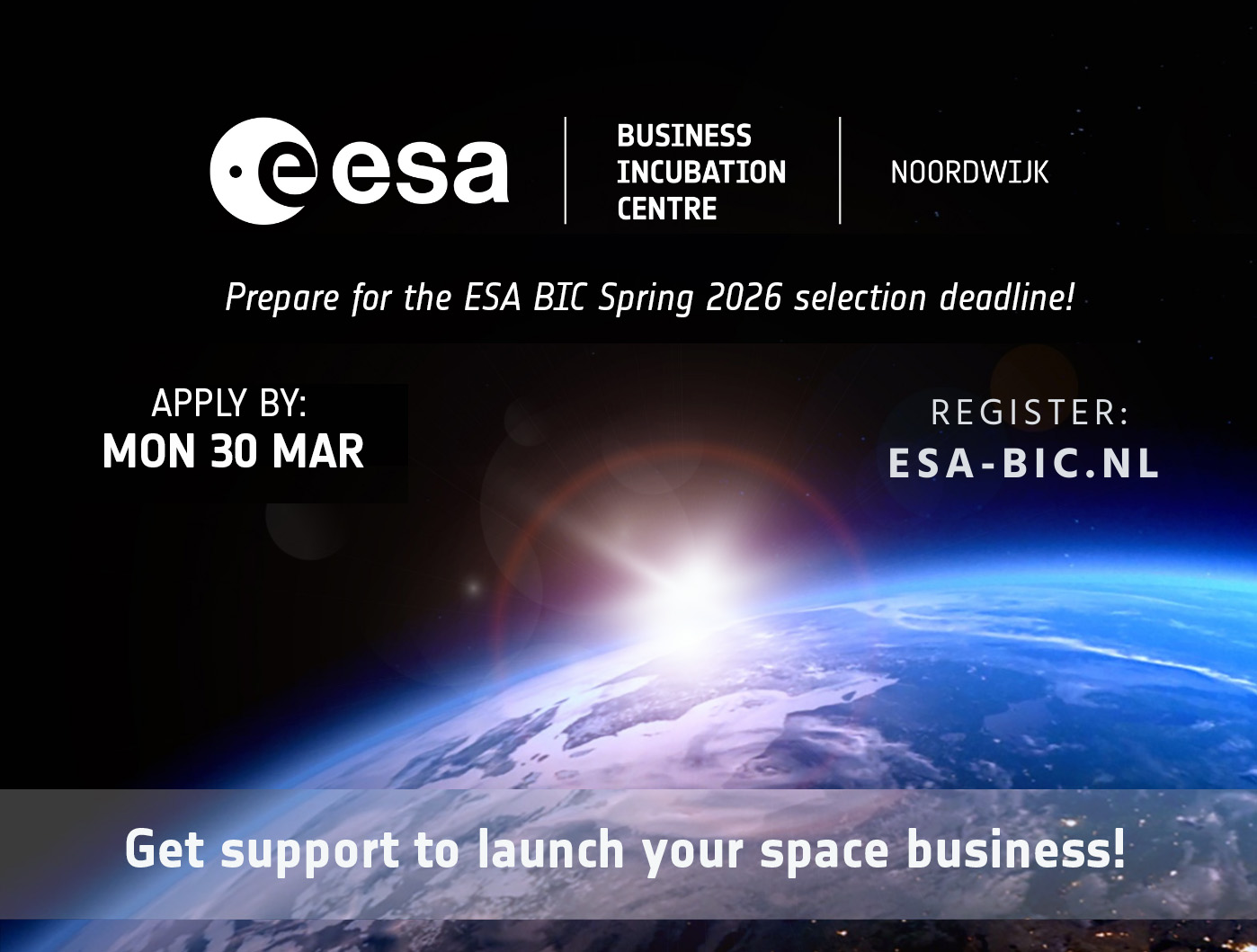
Apply by the next selection deadline: 30 March 2026
If you are interested to apply to ESA BIC, make sure you can explain your business idea’s space connection in the application process and emphasise your validated space link. Will the space asset of your innovation by downstream, technology transfer or upstream? In some cases, it can be evident what the space link is, especially for those entrepreneurs concentrating on upstream technologies or offering technology transfer innovations. However, for anyone building a business accessing everything that satellites are capable of achieving and looking to use space assets or resources for the development of downstream terrestrial applications, then just stating you will be “using Earth observation data” or “using satellite navigation” just doesn’t cut it. Discover more here.
Please take note: If you are using satellite data in your innovation, you also cannot simply just collect the data. You need to be carrying out innovative processing to add that extra something to your product. If you are creating an upstream product or service, you must first contact NSO. Details
Attend the info sessions & webinars for application tips: register via here
APPLY TO ESA BIC NOORDWIJK
You can apply to the Dutch business incubation programme of the European Space Agency, ESA BIC Noordwijk, if you are an entrepreneur or startup. The programme gives you the best chance of developing your space business idea via a well-established network and community in the heart of the Dutch space industry. You need to be resident in the Netherlands, with a company that is not yet founded or not older than 5 years. Then, the rest is up to you. Share your business proposal in the next application round and you could be joining our space community soon. Follow the pre-steps before submitting your application by one of the two selection deadlines per year. Join for the next webinar to find out more. esa-bic.nl
Prepare your space business idea for lift off!
Discover everything you need to know about the ESA BIC Noordwijk programme.
See also: