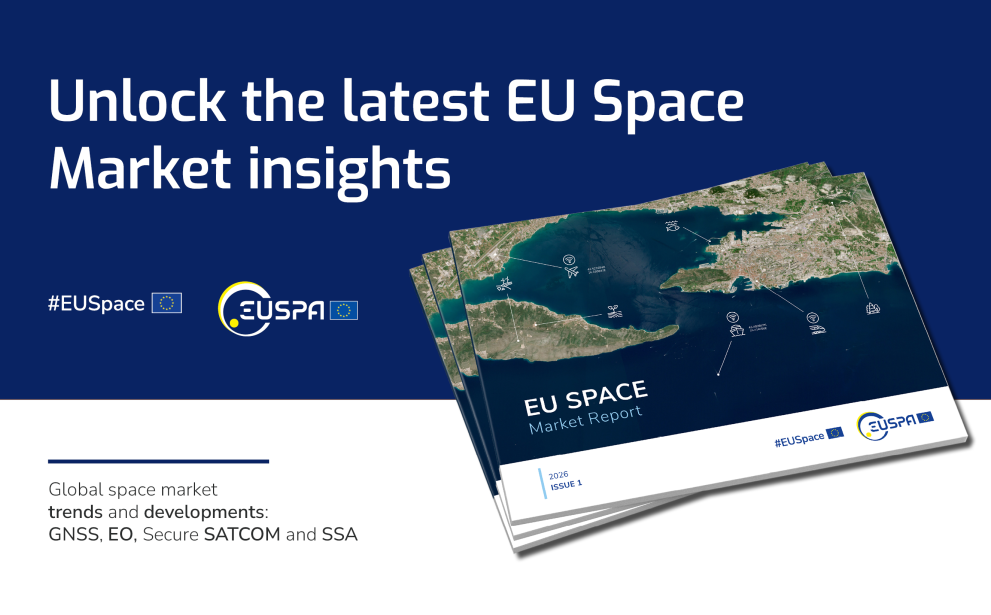
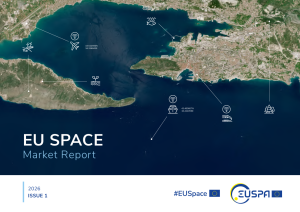
A new market report has been published by the European Union Agency for the Space Programme (EUSPA). It offers a comprehensive overview of the latest developments, emerging trends and market dynamics shaping the global space downstream sector. The EU Space Market Report 2026 (Issue 1) covers global navigation satellite systems (GNSS) and Earth observation (EO), as well as – for the first time – secure satellite communications (Secure SatCom) and situational awareness (SSA). It also highlights the evolution of user technologies and the growing synergies between these domains.
This is a repost of EUSPA’s news item; view original here and the press release here
Global downstream space market
With the increasing synergies between the four components of the EU Space Programme, it was time for a new market report to reflect this. The new and improved market report presents a comprehensive overview of the downstream space market, in terms of actual and projected revenues, capturing the market potential and impact, informing policy and funding decisions, and highlighting Europe’s role and strengths in a competitive, user-driven space economy.
The report also provides key supply and demand trends, insights into application markets and the evolution of GNSS, EO, Secure SatCom and SSA technologies.
Summarising market highlights and trends
- GNSS on the rise: GNSS revenue is set to reach 580 billion euros by 2034, overwhelmingly driven by mass market applications with consumer solutions, and road and automotive. GNSS-enabled devices in use are set to increase from 5.8 billion units in 2024 to almost 10 billion units by 2034. This ensures continuous, stable growth for GNSS over the next years.
- Earth observation: The current 3.5 billion euros of EO market revenue in 2024 is expected to grow to 7.9 billion euros by 2034 with agriculture representing the largest contributor.
- Secure SatCom and SSA: The Secure SatCom market addressing the needs of surveillance, key infrastructure and crisis management, data service revenues are expected to see strong growth, increasing from just over 200 million in 2025 to nearly 1.2 billion euros by 2040. While maritime surveillance represents the largest share of demand in 2025, the market is set to shift significantly over time. By 2040, applications such as law enforcement, civil protection and defence-related deployment are projected to take the lead as demand for security goes up. The SSA and its three sub-components – space surveillance and tracking, space weather and near-Earth objects will continue to play a prominent role as the need for space safety and sustainability increases.
- Sector highlights: Across sectors including agriculture, aviation and drones, consumer solutions, tourism and health, insurance and finance, urban development and cultural heritage, and EU border and internal security continue to demonstrate how EO and GNSS, complemented with secure satellite communication technologies enable more efficient resource management, safer operations, improved decision-making and enhanced resilience. These applications underline the growing importance of integrated space-based solutions in supporting Europe’s competitiveness and addressing societal challenges.
Existing and future synergies
The report also explores macroeconomic forces that are changing the space markets. Some of these factors, such as geopolitical instability, climate and urbanisation, highlighted synergies between the technologies:
- Geopolitical instability: EO, GNSS and Secure SATCOM allow for near-real time responses in unstable environments with heightened security risks and increased situational awareness. They are rapidly becoming vital enablers of security, resilience and informed decision-making. Space technology is also fundamental for operational efficiency increasingly required in segments like agriculture, energy and raw materials, as well as infrastructure, mitigating the impact of supply chain disruptions and increased prices for oil, pesticides and fertilisers.
- Climate change: Both EO and GNSS play vital roles in monitoring and environmental management. EO is central to assessing the impacts of extreme events and monitoring climate variables, while GNSS supports application for disaster response, environmental and infrastructure management.
- Urbanisation: Specifically in the South-East Asia region where urbanisation has increased rapidly, EOand GNSS work jointly to provide better urban and energy management and planning, urban development and downstream market growth.
Europe’s interconnected space capabilities
As Europe’s space capabilities become increasingly interconnected, it is essential to move beyond viewing them as standalone technologies. “Bringing together GNSS, Earth observation, Secure SatCom, and space situational awareness within a single publication reflects the growing synergies between these domains and their strategic importance for Europe’s economy, resilience and autonomy,” comments EUSPA executive director Rodrigo da Costa. “By providing a comprehensive view of the evolving space ecosystem, EUSPA aims to foster innovation, strengthen collaboration across the sector, and support the development of a more competitive, agile and responsive European Union space economy.”
This news release, issued by the European Union Agency for the Space Programme (EUSPA), was published on the EUSPA website on 26 May 2026.
###
NOTES FOR EDITORS
Report
The report can be downloaded for free here (PDF).
Contact
For further information about the new EU Space Programme report, contact Marie Ménard, EUSPA Communications Officer (marie.menard@euspa.europa.eu).
About EUSPA
EUSPA provides safe and secure European satellite navigation services, promotes the commercialisation of Galileo, EGNOS and Copernicus data and services, coordinates the EU’s governmental satellite communications programme GOVSATCOM Hub and the EU SST Front Desk. EUSPA is responsible for the security accreditation of all the EU Space Programme components. By fostering the development of an innovative and competitive space sector and engaging with the entire EU Space community, EUSPA contributes to the European green and digital transition, the safety and security of the Union and its citizens, while reinforcing its autonomy and resilience.
This is edited from the original news and press release published on the EUSPA website.
Discover which startups from the ESA BIC Noordwijk programme utilise space data: