Lens R&D, an alumnus of the European Space Agency’s business incubation centre (ESA BIC Noordwijk), has been contracted to supply 33 Sunsensors for ESA’s scientific space mission LISA (Laser Interferometer Space Antenna). The development of the sensor technology has been stimulated over the years with support from the Netherlands Space Agency (NLSA) through various ESA programmes. The recent order is a crowning achievement for the company and, to scale production of the sensors, Lens R&D will open a new manufacturing facility at PhotonFirst.
The following is an extract of news from the NLSA website
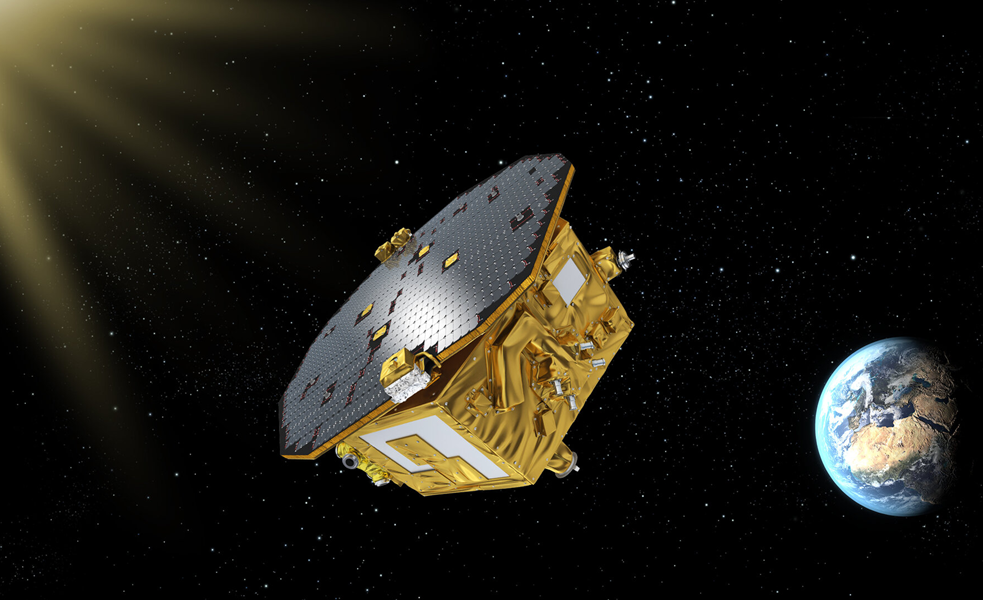
LISA is a European scientific space mission for research into gravitational waves. Starting in 2038, three satellites will fly through space 50 million kilometres from Earth, spaced 2.5 million kilometres apart. Using a laser link, minuscule changes in position between the satellites are measured. In this way, LISA can detect gravitational waves caused by supermassive black holes that merged in the early universe.
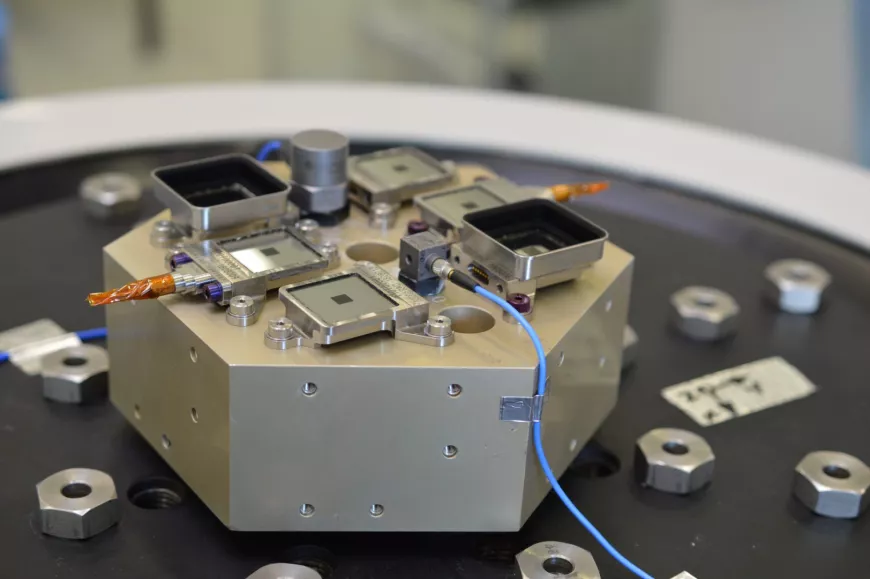
The LISA satellites must be perfectly oriented for the mission to succeed. This is done using so-called star trackers, which know what the night sky looks like. These star finders are intended solely for fine-tuning. If the satellites lose their full orientation for any reason, they search for a single star to determine their position again: the Sun. They do this using LRD’s BiSon64-ET Sunsensors.
Mission focus: ESA’s Laser Interferometer Space Antenna (LISA) will be the first space-based observatory dedicated to studying gravitational waves. It will detect ripples in the fabric of space-time emitted during the most powerful events in the Universe, such as pairs of black holes coming together and merging. Discover more
On top of the world
Johan Leijtens founded Lens R&D started in April 2012, at that time planning to develop sensors for solar farms on Earth. In 2015, he decided – during the ESA BIC incubation – to focus entirely on solar sensors for space. For this, the sensors were required to continue to function for 15 to 20 years in the vacuum of space, while being bombarded by cosmic radiation. And they needed to withstand temperature fluctuations from 105 degrees above zero to 65 degrees below zero.
It took 10 years to develop the sensors and qualify them for ESA so that they could be used on European space missions. The Netherlands Space Agency played a crucial role in this, first by selecting Lens R&D for the business incubator ESA BIC Noordwijk. Next came three awards under ESA’s ARTES programme and one award from ESA’s GSTP programme. The latter brought Lens R&D’s sensors to the ESA demonstration mission Proba-3, so that everyone has been able to see since last year: the sensors are working in space.
Read: Proba-3’s satellites launched carrying Lens R&D sensors >>
Scaling sensor production
When the technology was proved to work, there was interest from the market. But it was, and still is, difficult to secure the really big contracts, says the founder: “My company consists of only five people. In the eyes of major satellite mission contractors, that is far too small.”
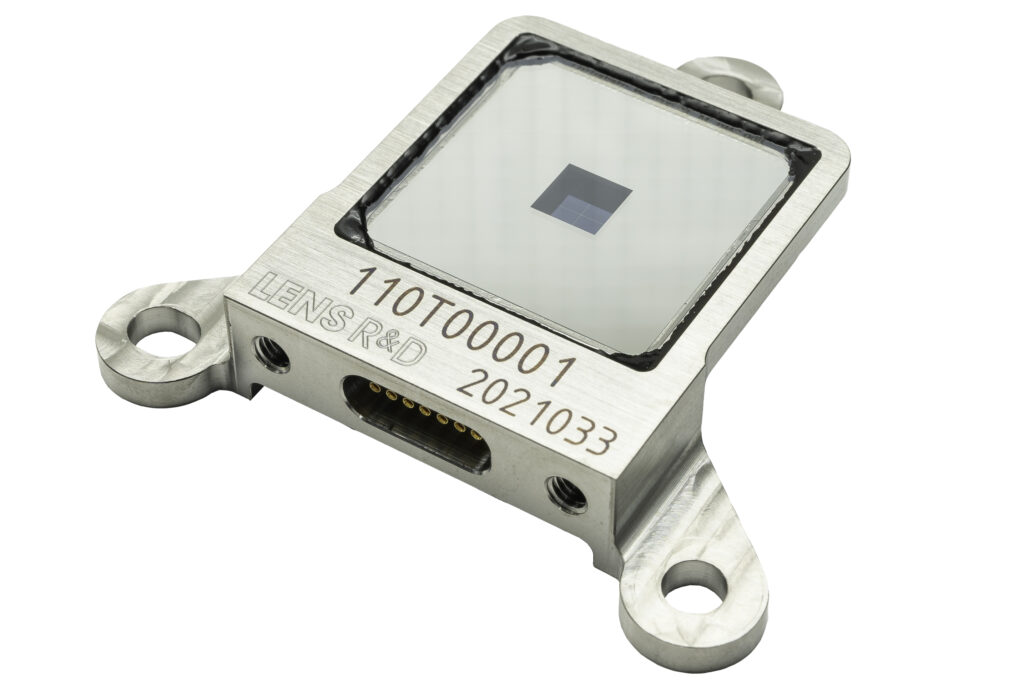
Therefore, in addition to ensuring the quality of the sensors, there was also an urgency to scale-up production capacity. Together with the company PhotonFirst in Alkmaar, it will soon be possible to realise a sustained production rate of at least 100 sensors per month.
Following the success of Proba-3, orders followed for, among others, the Martian Moons eXploration (MMX) rover and the Lunar Pathfinder communications satellite from ESA’s Moonlight programme. But the contract that Lens R&D secured for LISA at the end of February 2026 is a highlight: ”LISA is a major scientific ESA mission. If anyone ever asks questions about the quality of our solar sensors again, I will only have to point to LISA. The fact that we are flying on it says enough.”
Space is often a long-term endeavour – continue to invest, develop technology and believe in the product
Johan leijtens, Lens r&D
Continued investment in space tech development
With the order for LISA secured, the team are exploring a possible contribution to the European communications satellite IRIS2 (Infrastructure for Resilience, Interconnectivity and Security by Satellite) constellation. In addition, there is sufficient interest from international parties.
“Space is often a long-term endeavour. That certainly applies to the development of our solar sensors as well,” says Johan. “I am glad that I have continued to invest, develop technology and believe in this product all these years.”
NLSA is an incubation partner of SBIC; vIew this full news item via the NLSA website
About: Lens R&D BV is a systems engineering company specialised in optimising high reliability (electro-optical) sensors and systems for volume fabrication. This is done by combining a healthy level of innovation with many years of experience and background in the production of sensors and systems for both military and space applications. lens-rnd.com