ZemQuest is enhancing space tech battery design developed by NASA to enable innovative solid fuel cells. The goal is to use aluminium as an energy carrier. Currently participating in the Dutch business incubator of the European Space Agency (ESA BIC Noordwijk), the team is developing its first product for aluminium-based energy storage and is on a quest for zero emissions in mobile machinery. This innovative solution offers five times higher energy density than lithium-ion, high levels of safety and near-zero downtime. We caught up with CEO Michiel Kruijff to discover more about the sustainable and circular methods of ZemQuest.
Aluminium fuel cells are an experimental type of metal–air battery (or solid fuel cell) that use aluminium as the anode and oxygen from the air as the cathode. This forms the basis of ZemQuest’s innovation for transportable energy that can enable electrification of industrial vehicles, on-site and off-grid. This solid-fuel cell technology is emission-free, circular and safe, with reduced logistics hassle than lithium-ion and hydrogen. What makes it particularly suitable for powering large industrial vehicles is that aluminium has very high theoretical energy density, much higher than the current lithium-ion batteries that are widely used for electric vehicles and other applications.
Michiel Kruijff became co-founder of ZemQuest in August 2023 and, within a year, the company had developed an aluminium fuel cell as a single-cell prototype. The innovative solution has been capturing attention ever since. The company was awarded second prize in the technology transfer competition of the ESA Technology Broker NL in December 2023 and received the Wubbo Ockels Innovation Prize in November 2025.
Wubbo Ockels was the first Dutch astronaut, as well as a sustainability pioneer. He was also Michiel’s thesis and PhD supervisor when he was studying aerospace engineering at TU Delft some 30 years ago.

Discover more in the alumnus interview here; & watch a historic video featuring Wubbo, Michiel and colleague Erik van der Heide here
Now, the startup has found its way to ESA BIC with its headquarters at SBIC Noordwijk. There have recently been numerous opportunities to share its innovation – to a government delegation, a space manufacturing audience and at the SBIC Demo Day – since joining ESA BIC Noordwijk in July 2025. The team is busy progressing the development of an out-of-lab demonstration and sustainable full-style concept. Read on to hear from Michiel about how using space tech is beneficial for his startup’s solution.
How do you describe the focus of your startup?

We have kept our tagline – the future of green energy is looking solid – quite broad. The focus is aluminium as an energy carrier, making use of the high energy density of aluminium in the product. The core element is essentially the fuel cell – or, actually, a hybrid between a battery and a fuel cell. Since the fuel is solid, it will need to be mechanically refuelled, which is one thing we are investigating now as we fine-tune our exact value proposition.
What do you see your first product being?
We now have a prototype with a couple of cells and we’re investigating how to use that in a product that’s useful for the construction market. There are a few possible options; one is to use it as a swappable battery in the vehicle. This can lead to the range of the vehicle being increased by fivefold, which means you have to swap it only once a week instead of every day. So, this reduces the operational downtime. The other application is to have the electrical carriers in a container and use it to charge electric vehicles that the customers already have on-site. This would be a hub where vehicles can be plugged in locally. Right now, the current batteries (which can be up to 3 metres in length) need to be taken off-site every day to be recharged – and for every machine, they need a battery.
What problem is your solution addressing?
We provide transportable energy that has more endurance and less logistical barriers – because carrying those huge current batteries off-site every day is a major effort. We knew that there was this problem in the construction world and we were just looking for technology that could solve it. We started investigating this approach when we found that aluminium has the highest energy density.
Get financial support (€60K funding) to help launch your space business >>
How will you deliver your innovation?
By transferring technology from a NASA patent that was decades old, we have two new angles that make it successful. One is the market itself and opting for a single site where all the machines come together to get energy, rather than being distributed in a business-to-customer type approach. There have been other attempts at commercialising this technology, for example for consumer cars with the idea of having swapping stations wherever you get gas (petrol) – but that is a massive infrastructure. Our approach could have one site per construction project and you bring the vehicles there and we can deliver a massive amount of energy. So the economy scale is much easier to achieve in this way. By selecting a market that is more suitable – big machines that need to work all hours, every day and don’t have very high peak power – that fits very well.
The second aspect is the value chain and working with partners. In this approach, as we build partnerships with manufacturing and logistics companies, we focus on the reactivation of the aluminium, so the mechanical recharging would be part of the service and we’d get paid per reactivation; so, essentially pay-per-use. The business model would then be for selling the fuel, for which there would be a continuous stream of income – for a battery, you sell it once and then you don’t get benefit from it anymore.

What has been your initial focus during incubation?
The first thing I did during incubation was to add an extra durable, competitive advantage by working on a new concept of easily reactivating the aluminium batteries so they can even be reactivated on-site or in a central facility, in very few mechanical steps. So, this is something that we are really better at than others and this is now protected [patent application submitted].
What’s the space link in your innovation?
In 1987, NASA sought a solution for electrical energy in single-use systems and went on to develop an aluminium–air battery concept, for which several patents followed that have since expired. We have repurposed the original design, upsizing and enhancing it to allow mechanical recharging, with the addition of rapid reactivation capability. The original design was much more difficult to reactivate – almost behaving more like a primary battery that you use and then you need to disassemble it completely and then reassemble with fresh aluminium in it, which is no longer necessary with our approach.
How do you stand out from the competition?
There are big differences. So, there are some companies doing aluminium–air batteries but they are aiming at different markets, like consumer cars, which has the challenge of requiring gigantic infrastructure. There’s also a company trying to put it in airplanes, which is a great idea, but it requires a much more sophisticated design. And the airplanes need to be designed from the ground up to deal with this. You cannot retrofit airplanes like you can other vehicles.
The third market that’s being explored by other companies is in backup power. Right now that’s done with diesel generators, so if the energy grid for a hospital or data centre disappears, then the generators fire up and you get power. But there always needs to be a tank with fuel; it’s always there and is a fire hazard and it has to be regularly tested – so it’s an operational hassle. With an aluminium battery, you can have it standing there and when you need it, you just pour water into it and it starts working. For that, you sell a single-use battery that could be standing there for years not being used, whereas ours is a continuous flow. We believe that our business model is most likely to succeed.
There are a lot of other battery storage technologies but they are not really transportable solutions. They are really more like grid support systems. They are very bulky and you put them there to capture energy and release it, but they’re not really to bring to a site, not in an agile way.
“Our business viability objectives focus on sustainability and circularity – the goal is to be emission free”
michiel kruijff
What is your background and the expertise of your team?
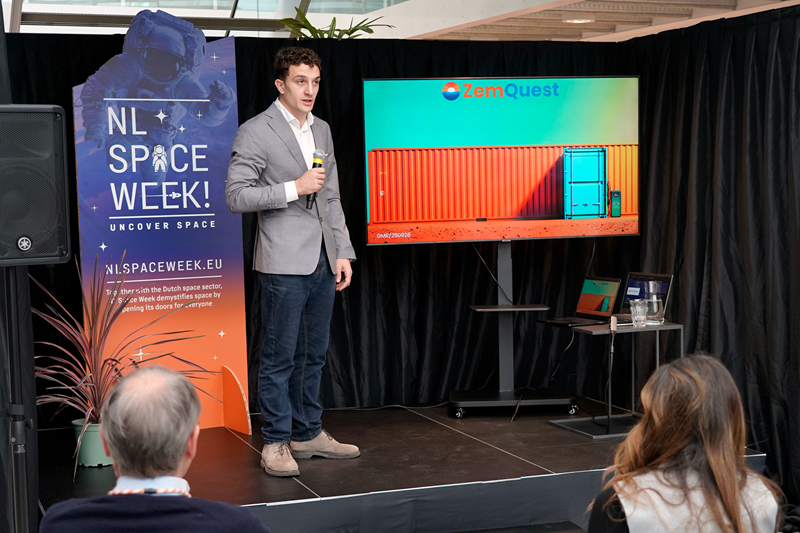
I’m an aerospace engineer, with a PhD in sustainability and space systems engineering from TU Delft, and I have over 25 years of experience in prototyping, systems design and team leadership. Gian Mario Rossi joined ZemQuest in Sep 2025 as business developer, bringing experience from four successful small companies where he explored markets and gained sales expertise. We are supported by other team members: Tilan Skobir, responsible for product testing and research, and Sudarshan Gokul who is researching the battery chemistry. Two freelancers – Daniel Bigott and Sebastiaan Engelen – have also been working with me from the beginning designing the batteries. Alongside the core team, we also work closely with assistant professor Moumita Rana at TU Delft where we can use the facilities to do testing on the chemistry.

What are you currently working on?
We’re building a prototype for an out-of-lab demonstrator, which is a 24 cell unit to power an electric vehicle. For the research, we are trying to make the sustainability cost affordable. So the aluminium, we’re trying to find a way to use low cost aluminium rather than the special alloy that we use right now. The goal is to be emission free, for which we will need to use recycled aluminium. We want to recycle our own aluminium, and then it’s best to have a very pure aluminium; if we recycle our own product, we have control over it and the less additives, the better.

TECHNOLOGY: In aluminium–air batteries, aluminium is combined with oxygen, drawn from the surrounding ambient air. This chemical reaction produces aluminium hydroxide and electrical energy. The electrical energy can then be harnessed to power a wide range of applications. The aluminium hydroxide can be filtered off from the electrolyte and either: be resmelted into fresh aluminium and placed back fresh into the battery, ready to be used again; or be sold as high-grade raw material (e.g. for high-temperature insulation).
Where will you be at by the end of incubation?
All the work we are doing is addressing various objectives, such as the business viability objectives where we focus on sustainability and circularity – because we don’t want to do this if it’s not sustainable. The final deliverable during incubation will be the minimum viable product (MVP). If the demonstrator that we are building works, then we’ll move on to having 25 of these cartridges connected together – and that will be our MVP because together they’ll power a big machine. We’re developing the multi-cell cartridges now. It all appears to be super modular and we’ll soon find out if it is possible. To build 25 of these cartridges will be cost intensive, so to get to that stage we’ll need funding.
What was your journey to the ESA BIC programme?
Essentially to avoid getting tunnel vision, I wanted to be surrounded by other companies and be part of the community. Of course, I had the aerospace background and I could also see other synergies. I was aware of this business incubator ever since a previous position I held at ESA ESTEC some 12 years ago. Prior to that, I had a company developing satellites and after working on technical applications at ESTEC for a few years, I wanted to be more entrepreneurial again. I joined a company of one of my ex-employees as CTO developing airborne wind energy. Almost 10 years later, I started looking for another challenge and this came up.
Any advice for any budding entrepreneurs?
If you start with a product and then approach the market, then you’re approaching in the wrong way. Be sure to first get validation and confirmation that your idea really solves the problem for the customer. Take a step back before you decide what product is going to fit to the needs of the market.
What organisations have been key for your journey so far?
We successfully completed the InnovationQuarter market readiness programme. This was a 10-week course of intensive market research that was very useful. We have also partnered with a number of companies for various projects. VDL is planning to run our solid fuel cell solution/demonstrator to power one of its automated guided vehicles in the port of Rotterdam.
And finally: What’s your favourite thing about space?
I like that we can learn just by observing, into space and from space – through light spectra, particles and gravity waves. Also, the system testing phase of your own satellite and the first ever close-ups of planetary surfaces: planets, moons, asteroids, comets.

ABOUT: ZemQuest, led by CEO Michiel Kruijff, is enabling emission-free and sustainable electrification for industrial mobility with aluminium–air batteries. The technology was originally developed for space applications and the enhanced concept offers five times higher energy density than lithium-ion, high levels of safety and near-zero downtime. Researching new developments in aluminium battery and solid fuel cell technology, recycling and distribution is how the company stays ahead. The team seeks to provide sustainable, effective and mobile power wherever it is needed. The company joined ESA’s business incubator programme at ESA BIC Noordwijk in July 2025. zemquest.com
Validate your business plan during pre-incubation!
Got a promising idea? Join the Ignition Programme to strengthen your concept and develop an insight-driven, validated business plan. Helps you to prepare a strong ESA BIC application: